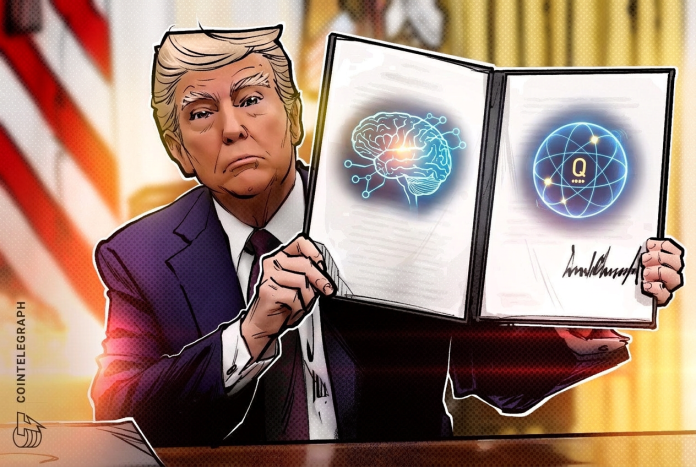
The Trump administration has unveiled an ambitious science and technology initiative that commits substantial federal resources toward quantum computing development and artificial intelligence advancement. The program allocates two hundred fifteen million dollars for a national quantum computing competition while securing two point four billion dollars in private sector AI commitments. This coordinated push reflects mounting recognition that quantum capabilities represent both an extraordinary opportunity and a systemic risk for digital asset infrastructure.
Quantum computing poses a direct threat to the cryptographic foundations that secure virtually every major blockchain network. Current encryption standards including elliptic curve cryptography and RSA algorithms could become vulnerable once sufficiently powerful quantum machines achieve cryptanalytic relevance. The timeline for this threat remains debated among experts but the consensus holds that preparation must begin years before practical quantum attacks materialize. The administration’s investment signals that federal policymakers now view this transition as a national security imperative rather than a theoretical concern.
The quantum competition component aims to accelerate domestic hardware development through a structured challenge format that encourages innovation across multiple technical approaches. Participating teams will pursue superconducting qubits trapped ion systems photonic architectures and other modalities in parallel. This diversification strategy acknowledges that no single quantum computing paradigm has yet proven definitively superior for scaling to the millions of qubits required for cryptographically relevant attacks. The program also emphasizes workforce development and supply chain resilience for critical components.
For the cryptocurrency industry the implications are immediate and practical. Major blockchain networks including Bitcoin and Ethereum rely on digital signature algorithms that quantum computers could theoretically break using Shor’s algorithm. While post-quantum cryptography standards are being finalized by NIST the migration path for decentralized networks presents unique governance and coordination challenges. Hard forks required to implement quantum-resistant signatures must achieve broad consensus across miners validators developers and users. The administration’s timeline adds urgency to these technical discussions.
Several forward-looking projects have already begun integrating post-quantum primitives or designing quantum-resistant architectures from inception. These efforts include lattice-based signature schemes hash-based signatures and multivariate cryptographic constructions. However widespread adoption remains limited and the window for orderly transition narrows with each advance in quantum hardware. The federal investment may catalyze standardization efforts and provide regulatory clarity that accelerates industry-wide migration.
The AI commitment component complements the quantum initiative by advancing machine learning capabilities that could optimize quantum error correction improve algorithm discovery and enhance cryptanalysis techniques. This convergence of AI and quantum technologies creates feedback loops that may accelerate progress in both domains. For blockchain security researchers this means defensive tools must evolve alongside offensive capabilities. The dual-use nature of these technologies demands careful policy frameworks that promote innovation while mitigating systemic risk.
Industry stakeholders should monitor the quantum competition milestones closely as they will provide concrete benchmarks for assessing the cryptographic threat timeline. Participation in NIST post-quantum standardization processes engagement with protocol governance communities and investment in crypto-agile architectures represent prudent strategic responses. The administration’s initiative transforms quantum readiness from a theoretical research topic into an operational priority for every serious blockchain project.