In recent months the cryptocurrency landscape has undergone a significant shift, moving from narrative‑driven price swings toward a fundamentals‑based reassessment. A growing number of investors and institutional analysts are now applying traditional finance tools-discounted cash flow models, price‑to‑earnings multiples, and comparable company analysis-to the world of decentralized finance (DeFi).
At the heart of this trend is the idea that a token’s price should reflect the underlying revenue stream of the protocol it represents. For DeFi projects that generate consistent fee income from lending, derivatives, automated market making, or stable‑coin collateral, the cash‑flow approach offers a clearer window into intrinsic value than speculative sentiment alone.
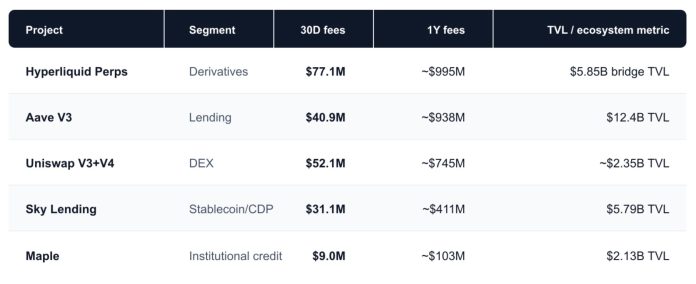
Using this framework, a recent research brief highlighted five tokens that appear to be undervalued relative to their projected earnings: Hyperliquid, Aave, Uniswap, Sky, and Maple. Each of these projects occupies a distinct niche within the DeFi ecosystem, yet they share a common feature-robust fee generation that can be translated into shareholder value.
Hyperliquid, for example, has carved out a leading position in the perpetual‑contract exchange segment. The platform’s fee structure, which captures a portion of every trade, has allowed it to accumulate a sizable fee pool that could translate into significant future cash flow. Analysts estimate that, if regulatory clarity settles and tokenized assets gain broader adoption, Hyperliquid’s revenue could surpass $40 million in the next fiscal year.
Aave operates in the lending arena and is often cited as a benchmark for transparent financial reporting in DeFi. Its protocol can generate approximately $60 million in earnings annually, according to the latest projections. When a 20‑ to 25‑times multiple is applied, the fair‑value market cap for Aave’s native token falls between $1.2 and $1.5 billion-a valuation that is considerably below its current market level during periods of heightened volatility.
Uniswap, one of the earliest and most widely used decentralized exchanges on Ethereum, continues to command a substantial share of trading volume. Its automated market‑making model produces fees that feed directly into the protocol’s treasury. The research indicates that Uniswap’s fee income could support a token valuation that aligns with a price‑to‑earnings multiple similar to those found in mature fintech companies.
Sky, a decentralized stable‑coin and collateralized debt position (CDP) platform, demonstrates the potential of stable‑coin ecosystems to generate predictable revenue. By locking collateral and issuing tokenized debt, Sky creates a steady stream of interest payments that can be captured as cash flow. When applied to a comparable fintech multiple, Sky’s token is positioned as a relative bargain in the current market cycle.
Maple, an institutional credit protocol, offers another example of fee‑based revenue translating into token value. The platform’s credit extension model allows it to earn interest from institutional borrowers, creating a reliable income stream that can be mapped onto a traditional valuation framework. Maple’s token, when evaluated under the same multiples used for the other projects, also shows a significant upside potential.
Collectively, these five tokens generate a combined fee pool that exceeds $200 million annually, according to the latest DeFiLlama data. The alignment between fee income and token economics is a critical determinant of whether a protocol’s cash flow ultimately benefits token holders or remains confined to the protocol’s operational budget. In each of the highlighted cases, the governance structures and capital allocation strategies suggest that a meaningful portion of revenue will be channeled back to the community, enhancing intrinsic token value.
For investors seeking a disciplined approach to DeFi investing, cash‑flow analysis offers a roadmap away from hype and toward sustainable growth. By focusing on protocols that demonstrate real revenue, transparent tokenomics, and disciplined capital deployment, market participants can identify assets that are poised to benefit from the broader crypto repricing that is underway.