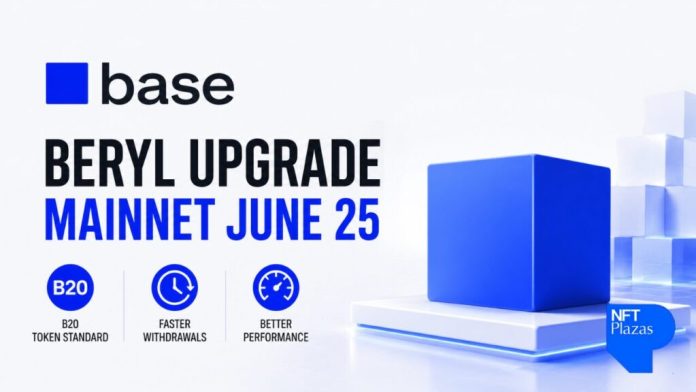
Base, Coinbase’s Ethereum Layer 2 roll‑up, has officially set June 25 as the mainnet launch date for its upcoming Beryl upgrade. This release marks the platform’s most technically ambitious enhancement since its debut, adding a native token standard and streamlining withdrawal times to Ethereum.
Since its May mainnet debut, Base has evolved from a simple scaling solution into a comprehensive ecosystem for token issuance. Its first upgrade, Azul, focused on improving node performance and withdrawal infrastructure. Beryl builds directly on that foundation, adding the B20 token standard, reducing the Ethereum withdrawal window from seven days to five, and updating the execution client to Reth V2.
The B20 token standard is the centerpiece of Beryl. Unlike the conventional ERC‑20 model that relies on smart contracts, B20 tokens are implemented as precompiled contracts within Base’s node software. The core logic is written in Rust and runs natively at the protocol level, eliminating the overhead of EVM bytecode execution.
Because B20 is an ERC‑20 superset, it retains full compatibility with existing wallets, exchanges, and indexers. Users and developers can interact with B20 assets exactly as they would with any other ERC‑20 token, without modifying infrastructure or onboarding new integrations. This seamless compatibility is a strategic choice that lowers friction for adopters and accelerates ecosystem growth.
B20 comes in two variants. The general‑purpose variant supports arbitrary token parameters, while a stablecoin‑specific variant enforces a fixed six‑decimal precision and allows issuers to define a currency code. The latter is tailored for regulated issuers who require built‑in currency precision from the outset, simplifying compliance and audit processes.
To empower institutional issuers, Base bundles an Issuer Toolkit alongside the B20 framework. The toolkit offers role‑based access controls, minting and burning functions, optional supply caps, transfer restrictions, and freeze‑and‑seize mechanisms. All these features are baked into the protocol, providing a robust compliance layer that reduces operational risk.
Security remains a top priority. Base’s internal audit team, in collaboration with the external firm Spearbit, has examined the B20 codebase. The audit report confirms that the precompiled contracts adhere to industry best practices, with no known vulnerabilities that could jeopardize token integrity.
Beyond the token standard, Beryl introduces several strategic improvements. The five‑day withdrawal delay to Ethereum cuts the wait time by two days, offering faster liquidity access for users. The upgrade also incorporates Reth V2, a modern execution client that enhances transaction throughput and reduces gas costs on Base.
Looking ahead, Base has outlined future enhancements to the B20 ecosystem. Planned features include the ability to pay transaction fees in B20 assets and further optimizations that could increase block processing speeds. These developments signal Base’s commitment to evolving the Layer 2 experience into a fully integrated token issuance platform.
For the broader DeFi landscape, Beryl’s introduction of a native token standard is a significant step toward simplifying stablecoin creation on Layer 2 networks. By eliminating the need for smart contract deployment and providing built‑in compliance tools, Base lowers the barrier to entry for regulated token issuers and encourages broader adoption of Layer 2 stablecoins. As the ecosystem matures, Beryl is poised to become a cornerstone for institutional asset issuance on Ethereum.