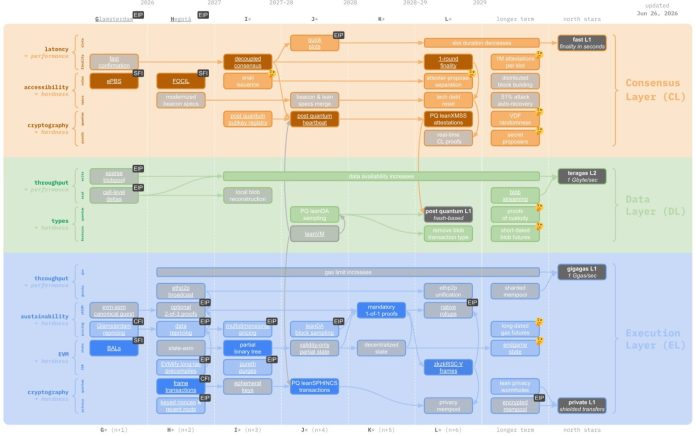
On July 6, 2026 Ethereum co‑founder Vitalik Buterin released a detailed update that moves the concept of Lean Ethereum from theory toward concrete research. The announcement follows a series of workshops that brought together cryptographers in Berlin and client developers in Svalbard, and it signals a multi‑year commitment to trim the consensus layer, improve validator privacy, and lay the groundwork for post‑quantum security.
The updated strawmap places Lean Ethereum on a trajectory that aims to deliver a faster, lighter, and more private layer‑1 protocol. While no hard fork has been scheduled, the roadmap identifies three long‑term milestones: a high‑throughput L1, a quantum‑resistant L1, and a privacy‑preserving L1. By aligning these goals with a streamlined consensus design, the Ethereum community hopes to reduce protocol complexity and accelerate future upgrades.
Buterin’s latest paper, titled “The Extremely Lean Chain,” concentrates on the beacon chain’s validator state. Today each validator stores a collection of fields-including a 48‑byte public key, a 32‑byte withdrawal credential, an 8‑byte active balance, and several status flags. As the validator set expands, the cumulative storage burden slows epoch processing and hampers efforts to move toward single‑slot finality.
The proposed lean design compresses the per‑validator footprint to a single byte for effective balance and a five‑byte index that references a global public‑key registry. All ancillary data-such as attestation participation, slashing evidence, and balance updates-would be supplied through succinct cryptographic proofs generated by the validators themselves. In practice, a validator would monitor its own activity, create a proof of correct behavior, and submit that proof to the chain, allowing the protocol to verify state transitions without maintaining the full data set.
This shift toward proof‑based state management promises several advantages. First, the reduced storage requirement lowers the cost of running a validator, which could broaden participation and improve decentralization. Second, because validators only need to expose minimal information, the design inherently strengthens privacy. Third, by relying on compact proofs rather than raw data, the protocol becomes more adaptable to future cryptographic primitives, including those designed to resist quantum attacks.
It is important to note that the Lean Ethereum proposal remains in the research phase. The Ethereum Improvement Proposal (EIP) process has not yet been triggered, and the community has not voted on any concrete implementation timeline. Nevertheless, the detailed strawmap and the accompanying technical document provide a clear framework for developers and researchers to evaluate, test, and iterate on the concepts.
Analysts see the Lean Ethereum initiative as a natural evolution of the roadmap that began with the Merge and continued through the introduction of sharding. By tackling consensus overhead directly, Ethereum can preserve its scalability ambitions without relying exclusively on layer‑2 solutions. Moreover, the emphasis on validator privacy aligns with growing demand from institutional participants who require confidentiality for large‑scale staking operations.
Looking ahead, the next steps involve extensive simulation of the proposed proof mechanisms, security audits of the reduced validator state, and community workshops to gather feedback. If the research validates the performance gains, the Ethereum Foundation may incorporate the lean consensus changes into a future hard fork, potentially synchronizing with other upgrades such as the anticipated post‑quantum cryptography transition.
For developers and investors, the Lean Ethereum narrative reinforces the blockchain’s commitment to continuous innovation. By prioritizing a lighter consensus, stronger privacy, and quantum resilience, Ethereum aims to safeguard its relevance in an increasingly competitive and security‑conscious landscape.