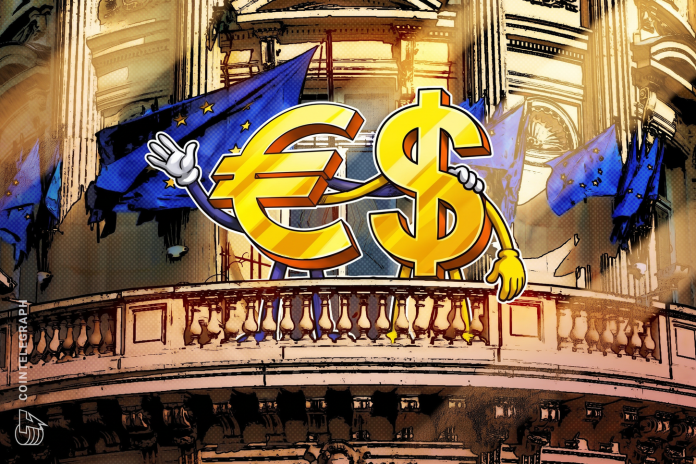
European stablecoin issuers are making a compelling case that euro-denominated digital assets alone cannot satisfy the region’s commercial requirements, emphasizing that businesses continue to demand dollar-pegged tokens for cross-border payments and settlement operations. This position emerges as the Markets in Crypto Assets regulation establishes a comprehensive framework for digital asset issuers across the European Union, creating both opportunities and constraints for local market participants.
The fundamental challenge stems from the enduring dominance of the United States dollar in global trade finance, commodity markets, and international banking relationships. European corporations conducting business with partners in Asia, the Middle East, and the Americas frequently require USD liquidity to execute transactions efficiently, and euro stablecoins cannot address this structural reality regardless of their regulatory compliance or technical sophistication.
Industry executives point out that the network effects surrounding dollar-denominated stablecoins such as USDT and USDC have created deep liquidity pools across centralized exchanges, decentralized finance protocols, and traditional financial infrastructure. These established ecosystems provide the depth and breadth that newer euro alternatives struggle to replicate, particularly for large-volume institutional transfers where slippage and counterparty risk become critical considerations.
Regulatory clarity under MiCA has actually strengthened the argument for USD token access, as European issuers can now operate within a defined legal framework while acknowledging market realities. Several prominent firms have indicated plans to launch compliant dollar-pegged stablecoins alongside their euro offerings, recognizing that a dual-currency strategy better serves multinational clients than a single-currency approach constrained by regional preferences.
The implications extend beyond simple payment utility into the broader decentralized finance landscape, where USD stablecoins serve as primary collateral, trading pairs, and yield-bearing assets across lending protocols, automated market makers, and structured products. European DeFi participants require seamless access to these markets without friction from currency conversion or regulatory uncertainty, making USD token availability a competitive necessity rather than a luxury.
Critics argue that reliance on dollar-pegged assets perpetuates monetary dependence and exposes European users to Federal Reserve policy decisions and potential sanctions risk. However, proponents counter that pragmatic market participation requires meeting customers where they operate, and the global financial system remains dollar-centric despite ongoing diversification efforts by major economies.
Looking ahead, the coexistence of compliant euro and dollar stablecoins under unified European regulation may create a more resilient digital asset infrastructure than either currency could achieve independently. This dual-track approach positions European issuers to capture both regional retail adoption and institutional cross-border flows, potentially establishing the EU as a premier jurisdiction for regulated stablecoin innovation while acknowledging the practical realities of global commerce.