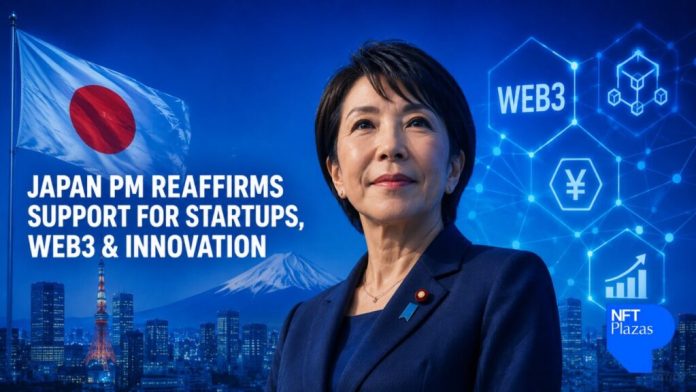
Prime Minister Sanae Takaichi used her virtual address at WebX 2026 in Tokyo to reaffirm Japan’s strategic focus on nurturing a vibrant startup ecosystem and accelerating Web3 adoption. Speaking to a crowd of founders, investors, and industry leaders, she positioned blockchain technology as an integral component of the nation’s broader innovation agenda rather than a niche cryptocurrency effort.
Takaichi emphasized that the government’s role is to create a regulatory environment that encourages entrepreneurship while providing clear pathways for capital formation. She highlighted recent policy initiatives that streamline licensing procedures, reduce administrative burdens, and align Japan’s legal framework with the fast‑moving demands of decentralized technologies. By coupling deregulation with targeted financial support, the administration aims to make Japan an attractive destination for both domestic and foreign Web3 ventures.
The prime minister underscored the importance of events such as WebX, describing the conference as a catalyst for collaboration between startups, established corporations, and venture capital firms. She noted that the gathering of roughly 15,000 participants creates a fertile ground for networking, knowledge exchange, and the translation of blockchain concepts into practical business applications across sectors such as digital finance, supply‑chain management, identity verification, and enterprise services.
In line with the Comprehensive Startup Support Package launched in 2025, Takaichi reiterated the government’s ambition to lift annual startup investment to approximately 10 trillion yen by fiscal 2027. The plan targets the creation of 100 unicorn companies and the growth of 100,000 startups nationwide, signalling a long‑term commitment to scaling Japan’s entrepreneurial capacity. Financial instruments backed by the state, including co‑investment funds and low‑interest loan schemes, are designed to increase capital accessibility for early‑stage projects while mitigating risk for private investors.
Regulatory modernization remains a cornerstone of the strategy. Recent amendments to the Financial Services Agency’s guidelines have introduced clearer definitions for tokenized assets and decentralized finance protocols, reducing uncertainty for developers and investors alike. By fostering a predictable legal landscape, Japan hopes to attract high‑quality talent and encourage the development of innovative Web3 products that can compete on the global stage.
While no new grants were announced during the speech, the prime minister’s remarks reaffirmed the continuity of the Five‑Year Startup Development Plan first introduced in 2022. The plan’s milestones include expanding public‑private partnerships, enhancing mentorship programs, and incentivizing corporate adoption of blockchain solutions. These measures are intended to create a virtuous cycle where successful startups inspire further investment, driving the ecosystem toward sustained growth.
Analysts view Japan’s approach as a balanced blend of regulatory clarity and financial support, positioning the country as a leading hub for Web3 innovation in Asia. By integrating blockchain technology into national economic policy, Japan distinguishes itself from jurisdictions that treat crypto assets as an isolated sector. This holistic perspective is expected to attract a diverse array of projects, from decentralized finance platforms to tokenized real‑world assets and AI‑enhanced blockchain applications.
Overall, the prime minister’s address at WebX 2026 signals a reaffirmed dedication to building a robust, future‑ready startup environment. The combination of deregulation, capital infusion, and strategic industry collaboration lays the groundwork for Japan to emerge as a premier destination for Web3 entrepreneurs and investors seeking a stable yet dynamic ecosystem.