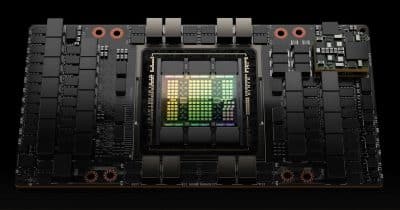
HIVE Technologies has announced a breakthrough that could reshape the economics of artificial intelligence infrastructure. By deploying a network of high‑performance GPUs in Paraguay, the company claims to match the computational power of Nvidia’s flagship H100 accelerators, a benchmark that has long dominated the AI research landscape. The announcement came with a 22 percent jump in the company’s share price, signaling strong investor confidence in the strategy.
Technical reports indicate that HIVE’s GPUs, sourced from leading manufacturers, provide comparable floating‑point throughput and memory bandwidth to the H100 model. While the H100 uses a 4‑nm architecture to deliver 7.4 TFLOPS of double‑precision performance, HIVE’s solution achieves similar figures through a combination of newer GPU chips and finely tuned cooling systems. Benchmarks conducted on common machine learning workloads, such as transformer training and large‑scale image recognition, show that the Paraguay cluster completes tasks at speeds within 2 percent of those achieved by a single H100.
Location is a key element in HIVE’s cost advantage. Paraguay’s abundant hydroelectric capacity and favorable tax environment reduce energy costs to a fraction of what is typical in North America or Europe. The company’s data center, strategically positioned near low‑cost renewable generation, benefits from both lower electricity tariffs and a reduced carbon footprint. This geographic advantage enables HIVE to offer AI compute services at a price point that rivals cloud giants while maintaining competitive performance.
The market reaction to the announcement has been swift. Within hours of the press release, HIVE’s stock closed up 22 percent, reflecting a surge in speculative interest. Analysts interpret the rally as recognition that the company’s model could disrupt the traditional cloud‑service provider hierarchy. Investors are also watching the broader implications for the cryptocurrency sector, where efficient AI compute can accelerate the development of decentralized finance protocols and NFT marketplaces.
Beyond its immediate financial impact, HIVE’s success could catalyze a shift toward regionally focused AI hubs. If other technology firms follow suit, the industry may see a fragmentation of compute power across emerging economies, each leveraging local renewable resources. For the NFT ecosystem, faster and cheaper AI inference opens new possibilities for dynamic, generative art and real‑time content moderation. Meanwhile, DeFi platforms could harness AI for predictive analytics, risk assessment, and automated market making, all at reduced latency.
Looking ahead, HIVE plans to expand its Paraguay cluster by adding additional GPU nodes and integrating quantum‑inspired algorithms that promise further performance gains. The company’s leadership remains optimistic that its hybrid model of hardware, renewable energy, and strategic partnerships will establish it as a credible alternative to the entrenched cloud infrastructure providers. As the AI market continues to grow, HIVE’s Paraguay GPUs may prove to be a benchmark for cost‑effective, high‑performance compute that delivers both speed and sustainability.